Visit my Patreon Page for more painting instruction and Paint Along Videos!

Saturday, August 31, 2019

New Video Release: How to Paint Better Shadows!


'Simple Pleasures'              8x10             pastel            sold

Shadows were the thing that challenged me the most....right after value!  When I would hear instructors talk about painting shadows I would be overwhelmed. Warm Light = cool shadows ...shadows on flat planes vs slanted....color and value of shadows.......It was too much information and I struggled to get my shadows to look believable.

I have learned some tips that have helped me. I have shared them in the past here on the blog and also through an in-depth unit on my Patreon Page. Today I am releasing one of the videos I shared in my Patreon unit on Light and Shadow. Click on the link below to see the video. Be sure to like and subscribe to my channel!


Here is the painting  before I fixed the 'bad' shadows. What changes do you think I made?


Head over to my Patreon Page for much more on painting light and shadows! www.patreon.com/karenmargulis

Friday, August 30, 2019

Are you Ready for Labor Day Paint-a-thon?


'Summer in Iceland'     7x11          pastel                ©Karen Margulis
available $150
I am sharing this post from my Patreon Page because I'd love for everyone to join us whether you are a Patron or not! 
Here is a challenge worth repeating! I did this challenge myself back in 2014. It was so much fun and I felt so energized and productive by the end of the weekend.  I am making a commitment to do this challenge again this year and thought it would be fun for our weekly challenge.......Introducing the Labor Day Paint-a-thon!Let me explain. 
When I did the challenge back in 2014 I was teaching in my studio so I had 12 easels. For the challenge I set up each easel with a painting. Some were older paintings that needed  a complete overhaul. Some were new paintings on blank paper.
  •  I took a pile of reference photos from a recent trip out west and matched the photos to the paper. 
  • I then went around the room and wrote down a story word for each painting......a word or two that expressed my concept for the painting. 
  • Next I went back around the room with a piece of soft vine charcoal and blacked on the big shapes of each painting. They were now ready for pastel! 
  •  I then spent any free time I had over the weekend to work on the paintings. Because I had spent time in the set up and planning stage I was able to complete all 12!
Below is a photo of the 2014 challenge paintings You can see the vine charcoal lines on each painting.   If you look closely you can see my Variation Challenge paintings on the wall behind my easels.

My studio set up for my last Paint-a-thon
This year I only have 5 easels set up in my studio but I think it is still a respectable number of paintings to attempt for a Paint-a-thon!  I am choosing up close and personal wildflowers as my theme. I will select 5 of my older reference photos with my personal challenge to find a way to reinterpret the photos in a new way.  I can't wait and I hope you will join me!
GUIDELINES FOR THE CHALLENGE
  • Set up at least 5 paintings to work on. They can either be brand new paper or a failed painting that needs a redo. If you only have one easel tape each painting to a separate piece of foam core so you can be more efficient.
  • Choose the reference photos. It is more fun to do a series or pick a theme.
  • Do some advance planning by putting a photo to a paper or painting. Come up with a story or concept for each painting and write down your story word so you don't forget.
  • Draw the simple shapes for each painting so that all of them are ready to go.
  • The key to success is to do this advance planning. This makes more efficient use of your painting time.
  • When it is time to paint turn up your favorite music and just let go! Don't overthink these paintings. This challenge is about having fun putting pastel to paper!


If you would like to share your working join us on Patreon we would love to have you! It is a $4 monthly subscription but you get a lot of great content and your support helps me spend time creating content for you! www.patreon.com/karenmargulis

Wednesday, August 28, 2019

A Tip for More Interesting Flowers in a Landscape


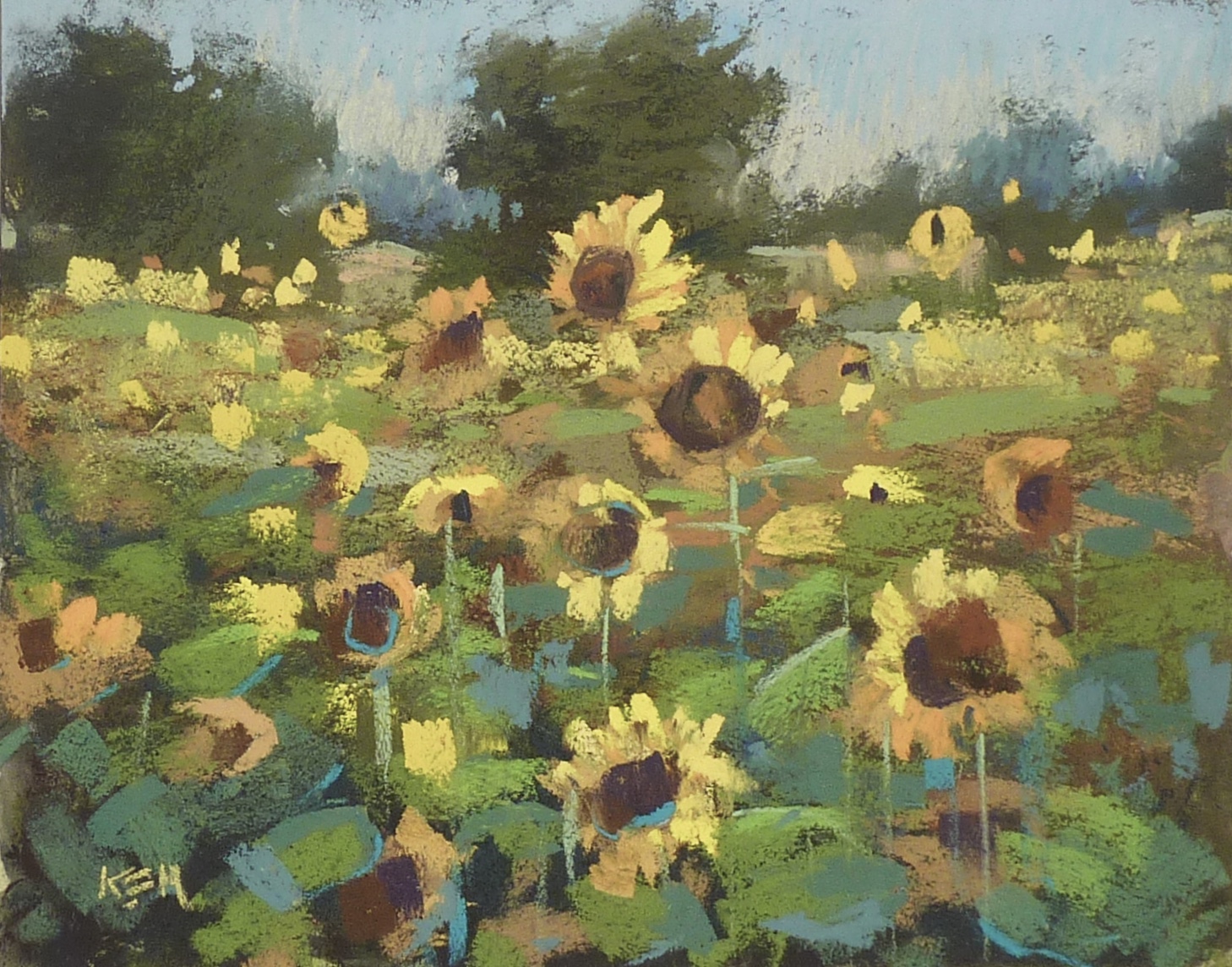
'Pick Me!'             8x10             pastel                   ©Karen Margulis
available $165
It sneaks up on us. Our logical brains want to organize and put things in order and before we know it we have a line of trees or flowers in our painting. But our brains also delight in things that are irregular and unexpected. It gives us delight. I once heard Jove Wang say it very simply ....."Even is Boring." Our job as artists is to look for the even and break it up and make things uneven and less symmetrical.

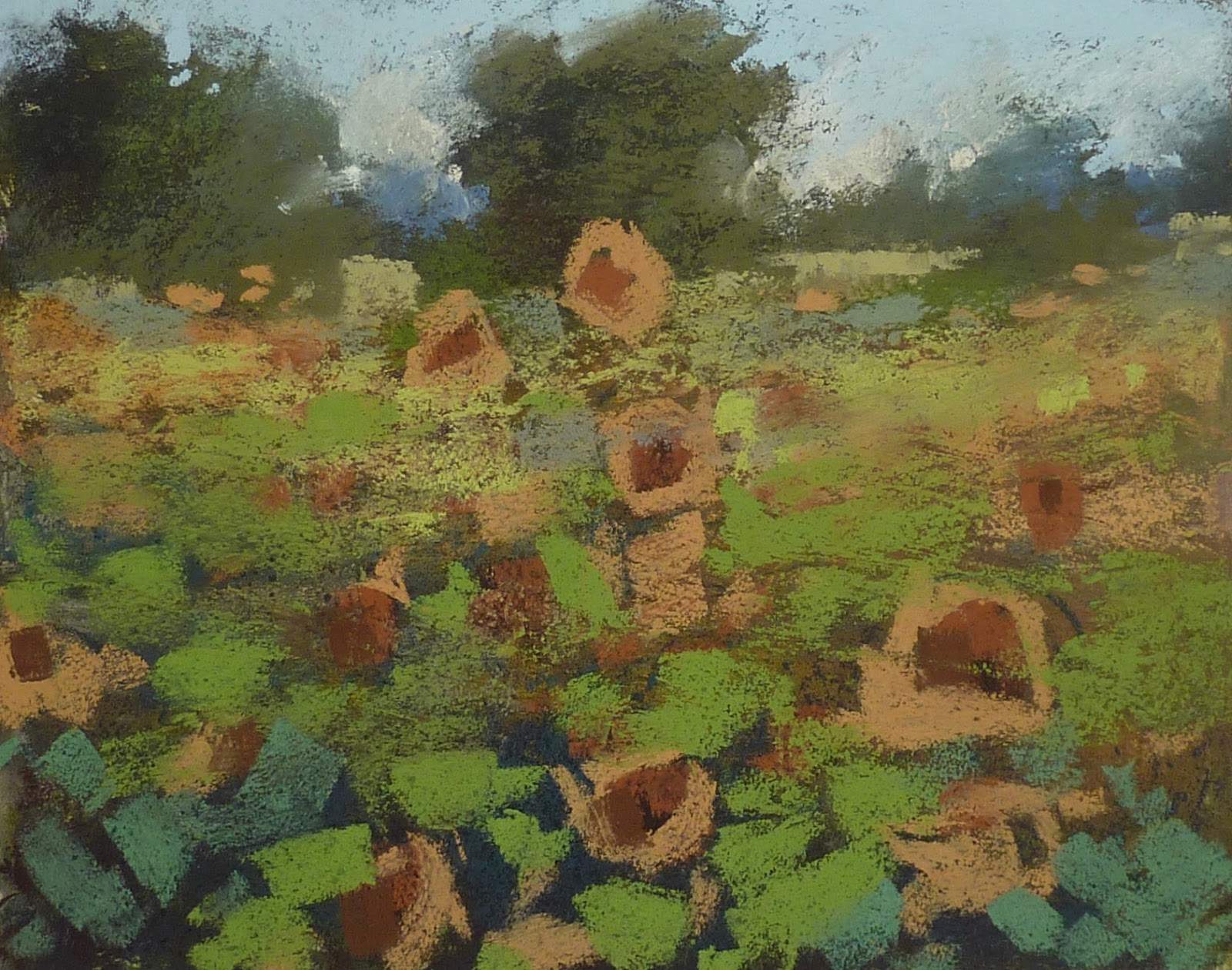
It doesn't matter how experienced you are .....this phenomenon happens to all of us. Take today's painting of a sunflower field. I was happily painting and adding in my sunflower shapes. When I stepped back it was clear. I had a straight line of flowers that were the same size AND they were in the middle of the painting! Could I get any more boring?!

Can you find the line of flowers?


What Do We Do to Avoid Even?
  • We need to be aware. We need to be on the lookout for objects that our brains organize too neatly. 
  • We need to step back from our painting frequently. We often don't see these things when we are on top of the painting. Step back at least every 10 minutes. 
  • We need to overcome any fear of brushing out areas of a painting and redoing them. We have to remind ourselves that the painting is not precious and it is OK to brush out an area and try again. Even if we love the painting and don't want to ruin it....brushing something out will make it even better!


I used an old stiff paint brush to brush out the even flowers

Painting notes: This sunflower field was painted on a reclaimed painting done on mounted 8x10 Uart. I used rubbing alcohol to paint over the old failed painting.


Monday, August 26, 2019

A Foolproof Way to Choose Underpainting Colors for a Painting


'Mountain Magic'          9x12              pastel              ©Karen Margulis
available $165

You've probably heard it before. There is no right or wrong choice when it comes to selecting underpainting colors. That is both comforting and scary at the same time! Imagine facing that big piece of blank paper. It is waiting for you to get started. You need to put down something....but what?  You can't really make a wrong color choice.....or can you?

I have learned through a lot of trial and error that while there is no right or wrong color choice for underpaintings....the colors you choose do have an impact of the final painting. Color choice does matter. It effects how the subsequent layers appear. It can change the whole mood and tone of the painting.

After many many paintings I find that underpainting color choices have become fairly intuitive. But sometimes I just want to be sure without making a big commitment of paper. 
I don't want to experiment with color choices on a good piece of paper! So I resort to a foolproof method....taking color notes.


The plans for my poppy meadow series

Color notes for the paintings. Top colors are final layer choices. 


Color Notes are quick and easy to do. It is just a matter of trying out potential color choices on a small piece of scrap paper. It is so much easier to see a variety of choices together. You can then choose the color combination that best suits your goal for the painting.  Here are some tips:


  • Use the same type and color paper for both the color notes and the painting. The colors will look different on other papers so this is important!
  • There are three parts to taking the notes....part one: choose the underpainting colors and make some small squares. Part two: choose the colors that you might use for the final layers (often the local colors) Part three: Make the underpainitng squares again and this time lightly layer the final layer color on top. Now you can see and judge how the colors work together.
  • Often I like to keep things simple when choosing underpainting colors and select ONE color with FOUR values of the color. So my color notes include a dark, light, middle dark and middle light values. I used this method on all three poppy meadow paintings.
This is a foolproof way of choosing underpainting colors because you can see the results of your color choices on a small scale with little effort and expense. You can quickly try many combinations without wasting your good paper on experiments. You do your 'what ifs' on scrap paper!


'Wandering Through the Poppies'               18x24               pastel with purple underpainting     IAPS demo    
'Poppy Walk'                15x21             pastel with yellow underpainting             
The bottom two paintings shown in today's blog are the result of using Color Notes in the planning stage. Each painting was done using the same colors. The Underpainting colors are the only thing that is different for each one. I was able to judge my results with the small notes before I committed to the big piece of paper. You can see that each underpainting choice resulted in a sublet but different feel to each painting. All paintings on Uart 500 with a mix of Mount Vision and Terry Ludwig pastels.


Would you like to see a video demo of today's painting? Head over to my Patreon Page where we have been studying foregrounds, grasses and flowers in a landscape. www.patreon.com/karenmargulis


Friday, August 23, 2019

What If Weekend: Experimenting with a Fun Underpainting

'Meadow Dreams'            12x9             pastel            ©Karen Margulis
available $175

It's Friday and time for a weekend of painting and exploring the wonderful world of pastel. I am devoting every weekend to trying a new technique or discovery. It will give me the weekend to play with something new! Of course I invite you to join me as I make new discoveries.

This week's inspiration came from an old Pastel Journal from 2002. Artist Schelly Keefer shared her technique of using Caran d'Ache crayons for underpaintings. She took the underpainting further by choosing complementary colors. I couldn't wait to get into the studio and pull out my small set of Caran d'Ache crayons and give them a try!

Caran d'Ache Neocolors II water soluble crayons 

These Swiss made crayons are actually water soluble wax oil pastels. Here is some information from the website:

 Type: Water-soluble wax oil pastel
– Soft, velvety texture, does not crumble
– Ultra-high pigment concentration, superior covering power, luminous colours, excellent light resistance
– CE EN71 and ASTM D4236 compliant
– Techniques: Wet or dry drawing on various materials, watercolour, wash drawing, scraping or for applying to light panels.


The application of the Neocolors before doing an alcohol wash. It was a lot like using crayons.

I decided to use mostly local colors for my underpainting. I thought these colors might make the finished painting more vibrant. I did use dark blue for the dark dirt and the base of the trees .I did a quick drawing on Uart 400 grit paper and then applied the crayons. I didn't press too hard and used linear scribbles rather than solid color.

Then I wet the crayon with a bristle brush and alcohol.  I loved how intense and vibrant the colors were. They just exploded with color! I once used water and I liked like how some of the wax didn't dissolve leaving some interesting areas in the underpainting.


After brushing on rubbing alcohol I add some more Neocolors. 

 Once dry it was time for the pastels. I tried not to cover all of the interesting underpainting. The pastel went over the dried wash without a problem. I was able to get as many layers as I needed. The neocolors didn't  fill the tooth of the paper.

It was a quick and easy way to do a wet underpainting. It was also a lot of fun!  

Before adding the final grassy details. 

Wednesday, August 21, 2019

Tips for a Watercolor Underpainting

'Journey's End'                 8x10             pastel              ©Karen Margulis
available $175

 It is elusive....that wonderful peek of watercolor under a thin veil of pastel. Sometimes I am successful and sometimes it doesn't go as planned. But I remind myself that the creation of a watercolor underpainting will influence the direction of my painting even if I completely cover it with pastel.

Still, that thought doesn't stop me from trying! I always approach a watercolor underpainting with the intent to allow a lot of it to show through the pastel layers. I want the wonderful drips, blooms and mingling of the paint to do much of the work.  But once I start layering pastel I often go farther than I wanted. Many a painting gets completely covered with pastel much to my dissappointment. How much pastel is too much? It is a personal preference. I love the contrast between the transparent watercolor and the opaque pastel so I want some of the watercolor to show. I've discovered some tips....
It is all about restraint. Work slowly and deliberately. Think about every pastel mark.


Here are some things I do to help me preserve the underpainting:


  • After the watercolor is dry I spend a few minutes evaluating it. Is there any area I love and want to be sure to save? Do I like the colors? Make note of these areas.
  • When I am ready to add pastel I begin by choosing colors and values that closely match the underpainting. I apply a VERY light layer so that I can hardly see the pastel. I will change color and value very gradually....small areas with a light touch. 
  • If I like the passage with this thin veil of pastel I will leave it and move on. In this way I don't get too heavy too quickly. I remind myself that it is OK to let the paper/underpainting show.
  • I find I most often overwork the pastel application  when I get too thick too fast. I then feel the need to keep adding heavier layers all over the painting. When I keep a light touch and work slowly I have more success.

Today's painting was inspired by my recent cruise to Alaska. I used a watercolor underpainting on an 8x10 piece of mounted vintage white Wallis paper. 

Monday, August 19, 2019

How to Paint Richer Grasses with Pastel

'The End of the Rainbow'                 8x10              pastel             ©Karen Margulis
available $165

If it is green and growing then it need some DIRT!  I have discovered that if I add some rich darks and interesting dirt colors UNDER the grass it gives my landscapes with grassy areas more with depth and volume. This simple step has made a huge difference for me. 

So how do we add the dirt? There are many ways but usually through an underpainting of some kind. When I block in my composition in the underpainting I always make sure I use something dark and colors other than the local colors.

For today's painting I created the dirt by brushing some alcohol over a failed painting. The alcohol liquified the pastel and blended the colors together to make mud. Most of the time we don't want mud but this time I did! It was a great dirt color. I added a sprinkle of gold powder from Schmincke.....just because I thought it might add the effect of gold leaf. Below is the resulting underpainting ready for some grass!


8x19 on Uart 400 sanded paper

The next step for me is to reinforce the dark areas. I use a dark blue pastel on the side to do this step.  But the dirt is established and now my grasses will have a richness that might not otherwise be possible!


If you'd like to see more photos in this mini demo have a look at my Patreon Page. I'd love for you to join us for just $4 a month! www.patreon.com/karenmargulis

Saturday, August 17, 2019

New Video Release: How to Paint Landscapes that Glow


Would you like some tips for painting light and shadows? You can search this blog for some great information. You can also head over to my Patreon Page where we spent two months this year covering these topics. If you would like to see one of the videos I made for my Patreon group it is now available on my YouTube channel. ( I have over 100 videos available on my Patreon Page!) In this video I show you how I paint flowers that glow with warm sunlight. Click on the link below to watch the video. If you like what you see please give it a thumbs up or comment and be sure to subscribe to my channel! Your support of my efforts helps me create even more content for you!

https://youtu.be/lQdAVmRtZak


The finished demo painting. Sold


Here are a few tips for painting the illusion of warm sunlight

  • When painting a landscape it is important to know what time of day and what weather conditions you wish to portray. Warm light occurs in early morning and late afternoon (sun is low in sky) Cool light occurs mid day and overcast conditions.
  • The idea that warm light = cool shadows means that if the light source is warm the shadowed areas will be cool (not just the cast shadows on the ground....but any area not lit by the sun)
  • The secret to painting warm sunlight is to use a warm color in the areas KISSED BY THE SUN and use a cooler/duller color in the areas not kissed by the sun.


Thursday, August 15, 2019

Taking a Painting from Finished to REALLY Finished!

'Head North'             9x12                pastel                   ©Karen Margulis
available $175
I just didn't listen. I had been given great advice but I guess I just wasn't ready to listen or more likely I didn't understand the importance of the advice. SLOW DOWN. I heard it from my teachers from my early days of painting (12 years ago). I couldn't. I was too anxious to paint and finish. Why should I slow down? I had learned to paint fast because of my busy work schedule. Painting 10 minute studies every day will do that. But I didn't learn to slow down to resolve those paintings!

I had to come to that place by myself. When I was ready. Lately I have embraced the art of slowing down....both in planning a painting and resolving it. Take the painting in the photo below. I painted it a few years ago. I signed it and put it in a clear bag to bring to workshops. I must have thought it was finished! But when I pulled it out and looked at it I could see several things that could be adjusted.  Some of them I might have noticed if I had taken the time to slow down and make my finishing marks with more care. Sometimes we just need time and experience before we can see these things with our own eyes and that is OK. It is part of the journey. 

The original painting needed help!
So what did a slower approach tell me about this painting? It needed an adjustment to the tree line. They were all in a row and the dark band of distant trees was too dark and distracting. I could have fixed the palm trees but instead decided to turn them into evergreen trees inspired by my trip to Alaska.

The painting also needed a more interesting foreground to middle ground. This area was too large and boring in the original painting. I used some workable fixative to rework this area. I spent about an hour on  this foreground area which is quite slow for me! But in the end the painting is much more interesting and polished. Slowing down to make these finishing marks made the difference.

For more tips on painting foregrounds visit my Patreon Page. For a $4 monthly subscription you will have access to over 2 year's of lessons and demos! www.patreon.com/karenmargulis

Tuesday, August 13, 2019

How to Decide What to Paint First After a Trip

'Summer in Alaska'                 9x12                    pastel               ©Karen Margulis
available $175
I woke up to 4 suitcases staring me down. Would I spend the day unpacking and doing laundry or would I paint. Of course I was anxious to paint. I came home from my cruise to Alaska filled with inspiration. But the thought of those suitcases eventually won out. I decided it would be better to start with a clean slate and a clean studio!


Add caption


It really wasn't as bad as I thought it would be and by late afternoon I was finished unpacking and the easel called my name. This would be the tricky part. What would I paint first from all of my Alaska photos? What would call my name? I scrolled through my downloaded photos and selected 6 to print. I had taken over 1000 photos so it wouldn't be practical to print them all out.  I like to print about 6 or so at one time...use them for inspiration for a week and then revisit the photo files on my computer and choose another six photos. This not only makes it manageable it also allows me to revisit the photos with a fresh eye. What inspires me one day might not speak to me on another.

I print my photos no larger than 4x6 on regular printer paper


Usually after a big trip such as this one to Alaska I will paint from the photos for 2 - 4 weeks after the trip. Each week I will look for new subject matter within my photo files. Then it is time to move on. The photo files stay on my computer  (backed up twice of course) and the paper photos I printed stay in a marked envelope. I will often pull from these photos month and even years from the time of the trip. This is inspiration that keeps on giving!

Monday, August 12, 2019

The Magic (and frustration) of Green Pastels


The Magic of Green Pastels

'Summer Magic'         16x20          pastel           ©Karen Margulis
Enjoy another post from the archives. I will be back to regular posting this week!

 Greens can make us crazy!  Pastel artists can't really mix our own greens so we have to have a variety of green pastels in our collection.  (we can adjust our greens somewhat...more on this in another post)  Our green collection grows as we discover the limitations of our basic pastel sets.
  • We learn that the vivid artificial looking greens in the basic beginner sets can be too garish for believable landscapes.
  • We realize that in order to create depth (aerial perspective) in our landscapes we need a variety of warm, cool and neutral green pastels. We also need a range of values. Basic sets often only include mostly middle value bright greens. 
  • With practice we start to see the difference between warm, cool, intense and dull and we begin to understand where to use them. At first we may not see it. I know I didn't. Green was green and I couldn't understand why we would want (and covet) a full set of Terry Ludwig Greens!  But lots of practice has developed my sensitivity to green and I would LOVE that full set.

Having the right greens and using them in the right place can result in magic! I learned this first hand on my Iceland trip. I didn't have the right greens in my travel box!


'Emergence II'    8x10  plein air pastel    
Iceland was very lush and green. But I didn't anticipate just how cool those lush greens would be. I had my usual very limited travel set and my Gogh Box. I didn't have a lot of pastels so my selection of greens was limited. I just didn't have the right greens. I had a variety of light, middle and dark greens and a couple of cooler greens. But overall my greens were warmer yellowy greens.

I was in Iceland with no art store nearby so I had to make due with what I had. I was able to capture the values in my plein air studies but would have to wait until I got home to reinterpret these studies with a better selection of green. It was a valuable lesson!

Look at the difference the greens can make in a painting. The larger painting at the top is my studio painting. I used the smaller study as a reference and changed the selection of greens to better represent the lushness I saw.

I invite you to read my travelog about my trip to Iceland complete with photos and paintings. Links to each chapter can be found on my Pinterest board here. 

Saturday, August 10, 2019

Behind the Scenes: Painting a Heron and Egret


'The Wild Side'        9x12      pastel      ©Karen Margulis     sold

Enjoy this post from the archives. Would you like to see more animal paintings? I hope to get some wildlife photos in Alaska!)

I'm nosy. I like to be an observer of everything. Sometimes I get so involved with my people watching and observations that I forget that I am not really invisible. I am just very curious. It's not just people watching that intrigues me...I love watching art come to life. I enjoy seeing artists post their progress shots and even better when they give a commentary. I love learning how other artists approach a painting. 

So today I will take you behind the scenes of my egret and heron painting. I took some progress shots and I have added my thoughts below each photo. I hope you enjoy a peek behind the scenes.


I am using a 9x12 piece of Uart 500 sanded paper. I begin with a drawing done with compressed charcoal. I just dive right in with the charcoal and make any corrections without erasing. This is a totally different technique from my landscapes. It just illustrates that there is no right or wrong way to start a pastel painting!


I decide to start with the heron. I began by blocking in the darkest darks and then the middle values and finally the lightest areas. I usually work on the entire painting at one time including the background but for some reason the heron went quickly and I decided to finish him. Sometimes you just go with the flow!


Next I painted the egret. There is not strong dark so I began by using a middle value blue and purple before add ing the lighter value whites. I have left the dark charcoal lines on both birds. I love lines and I liked how they gave the birds a looser more expressive feeling. They are my interpretation of these wonderful birds....not a photorealistic representation.

I also added some of the dried marsh grasses with a few different yellow and orange pastels. Now the hard part, the background ....I never wait until the end to put in a background!


I wanted the birds to have a backdrop of water so I used several different blue pastels to sneak the water behind them. I was careful to pull the blue all the way into the birds. I didn't want to leave a halo of paper color around the birds.  I used blue to negatively paint in between the grasses. That was fun!  I love painting animals this way! Directly, fast with no underpainting!

4x4 study
Here is another favorite painting os a snowy egret. I enjoy the square format for these birds!

Thursday, August 08, 2019

Why Bother with Painting en Plein Air?


'Back to Abiquiu'            24x18            pastel        ©Karen Margulis
While I am in Alaska I am sharing some posts from the archives. Enjoy!

It has been a long time coming. I have been wanting to paint this scene for a couple of years now. My plan was to take the little field study I painted and paint a larger version in the studio. I envisioned it big ... 18x24 which is big for me. I framed the little study because it came attached with great memories. It sat in my studio and I would look at it and tell myself that someday I would paint it larger. Today was the day. But did I wait too long? I was a bit concerned as I took out a full sheet of Uart paper.

Would I remember the place and be able to capture how I felt about it after a few years had passed?

I need not have feared. As soon as I took a good look at the little 5x7 study it all came flooding back. I recalled every detail of the afternoon painting on the bluff overlooking the Chama River. I remember it was a warm day but with a gentle cooling breeze. I remember taking out a piece of 5x7 paper and deciding to tone it orange because of all of the warm rocks underlying the scrubby bushes. I remember hearing the water and some ravens. I remember feeling at peace....happy to be in New Mexico and enjoying the first day of a mentoring workshop with Richard McKinley. Looking at the little study brought back the memories that all of my senses took in that afternoon.


The 18x24 painting with the 5x7 study
I don't think I could have recalled the place so well by looking at a photograph. The time I took to paint the scene...to choose the colors...to simplify...to immerse myself, allowed it to become a part of me. It was worth the time and effort required to take supplies outside to paint.

Why bother? I was once asked. Why hassle with equipment and the elements when you can paint in the comfort of a studio? Why? Because it is the best way to really see what photos miss. It is a wonderful way to fully experience your subject. It is the best way to put more of yourself into a painting. Your response to a place live and in person is better than relying only on a photo.


I did an alcohol wash underpainting for the large painting
Here is an excerpt from the blog post I wrote on the day I painted the study:


 We painted from morning until the sun sank behind the cliffs. It is a dream come true. The opportunity to paint in such an inspiring place with a group of artists who are passionate about what they do is priceless. Today was the first day of the workshop with Richard McKinley and since this is a mentoring or next level workshop the morning meeting was short but filled with great advice. Richard issued us a challenge for the week: To be more conceptual....go deeper....be more present.....go beyond the mechanics of painting....go farther! 

Our first painting location was a spot high above the Chama River. Yesterday I painted at the river bank....today I was like a raven soaring over the river as it rounded the bend. It was fantastic. I did 4 studies and had a wonderful time.